Bone Conduction Tactical Earpiece
The Challenge
Traditional audio devices block ambient sound, creating safety risks in environments where situational awareness is critical. Commercial bone conduction devices compromise on either audio quality or form factor.
Our Solution
Custom-engineered bone conduction earpiece delivering clear audio transmission through the skull while keeping ears completely open — from circuit design through production-ready prototype.
Results & Impact
Purpose-built circuit board optimized for bone conduction transducer driving and power efficiency
Rapid iteration from concept to functional prototype through additive manufacturing
Clear audio transmission through bone conduction without blocking ambient sound
Complete engineering package with documentation ready for manufacturing handoff
The Design Challenge
In construction zones, factory floors, tactical operations, and athletic environments, conventional earbuds and headphones create a dangerous tradeoff. Users get audio — communications, alerts, instructions — but lose awareness of their surroundings. Machinery sounds, approaching vehicles, verbal warnings from colleagues — all masked by a speaker sealed against the ear canal.
Commercial bone conduction headsets exist, but they're designed for consumer fitness use. They're too bulky for helmet integration, too fragile for industrial environments, and their audio quality degrades in noisy conditions. The client needed a purpose-built device: compact enough to wear under a helmet, rugged enough for daily industrial use, and clear enough to deliver voice communications in environments exceeding 85 dB.
Talk to Our Engineers
The people who built this are the people you'll talk to. No sales team in between.
Start a Conversation →The Engineering Approach
Big0's hardware team worked through the full product development cycle — electrical design, mechanical design, firmware, and integration testing.
Circuit design started with the transducer. Bone conduction drivers have different electrical characteristics than conventional speakers — they need specific impedance matching and amplification profiles to produce intelligible speech through bone. The custom PCB integrates a low-power amplifier tuned for the selected transducer, Bluetooth connectivity, battery management, and microphone input on a board small enough to fit behind the ear.
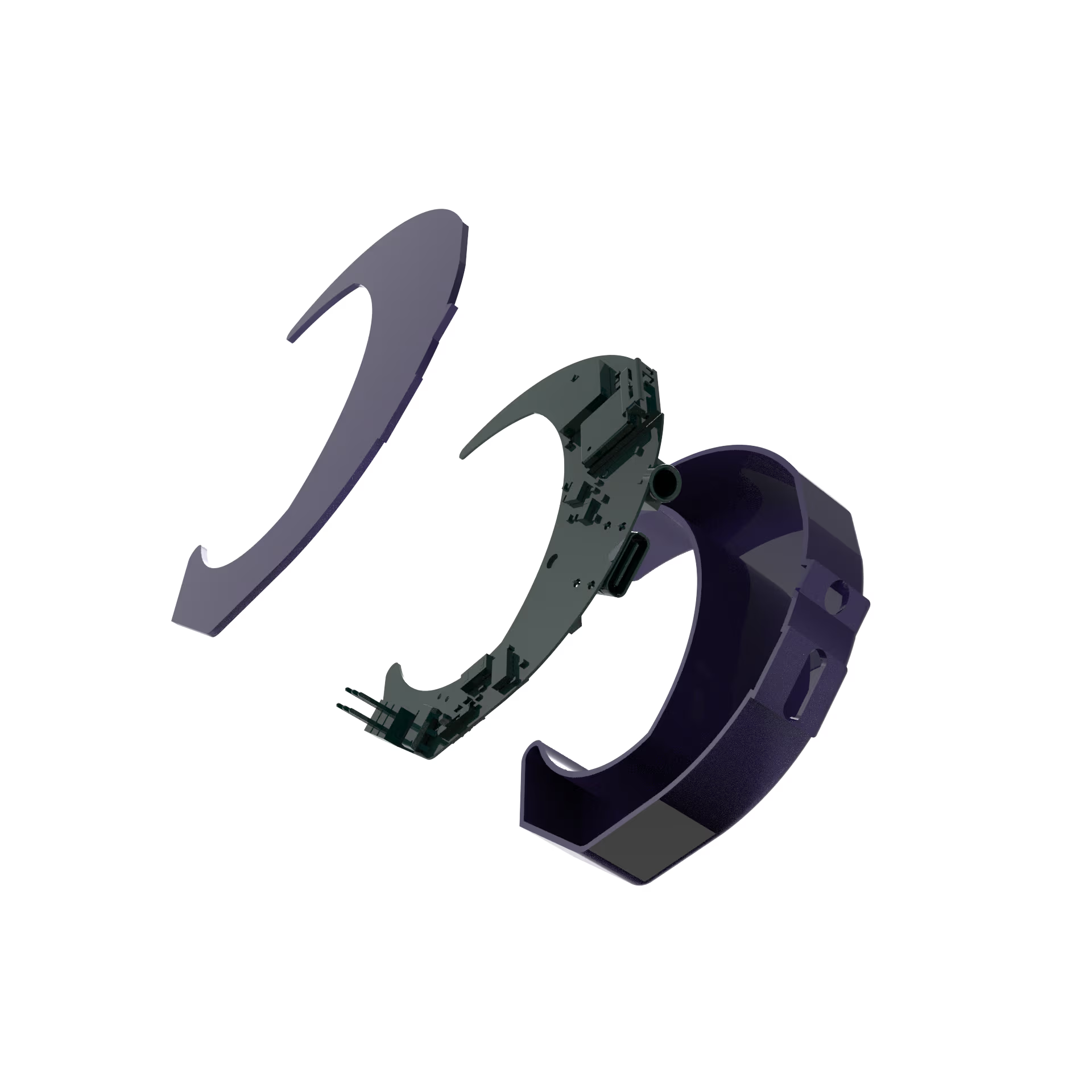 Custom PCB with bone conduction transducer and Bluetooth module
Enclosure design went through multiple iterations using 3D printing. Each revision refined the contact pressure against the temporal bone — too light and audio becomes thin, too heavy and extended wear becomes uncomfortable. The final form factor sits securely without blocking the ear canal, weighing under 30 grams.
 3D-printed enclosure optimized for contact pressure and extended wear
Firmware handles Bluetooth pairing, audio processing, battery management, and power states. A low-power sleep mode extends battery life during intermittent use. The audio processing pipeline includes noise filtering tuned for voice frequencies — prioritizing speech intelligibility over music fidelity, which is the right tradeoff for the use case.
Validation and Testing
The prototype was tested across environmental conditions — indoor and outdoor, quiet and noisy. Speech intelligibility was validated in ambient noise levels matching industrial environments. Battery life, Bluetooth range, and mechanical durability were characterized through structured testing protocols.
The contact mechanism was tested across different head sizes and shapes. The mounting system accommodates variation without tools or adjustment — it works or it doesn't, and the design needed to work across the range.
The Deliverable
The project delivered a complete engineering package: schematic files, PCB layout, bill of materials with sourced components, 3D models for tooling, firmware source code, and test documentation. Everything a contract manufacturer needs to move from prototype to production.
The development approach — simulation-informed design, rapid prototyping through 3D printing, iterative testing — compressed what would traditionally be a lengthy product development cycle. Each design decision was validated physically before committing to the next stage, reducing the risk of expensive late-stage changes.
The earpiece demonstrates that specialized hardware products can be developed efficiently when the engineering team controls the full stack — electronics, mechanical design, and firmware — rather than integrating off-the-shelf modules that don't quite fit the requirements.
Talk to Our Engineers
The people who built this are the people you'll talk to. No sales team in between.
Start a Conversation →How We Built It
Talk to Our Engineers
Not salespeople. Engineers who've built production AI, shipped hardware, and published research.